Tree Conference: The Science and Beauty of Trees

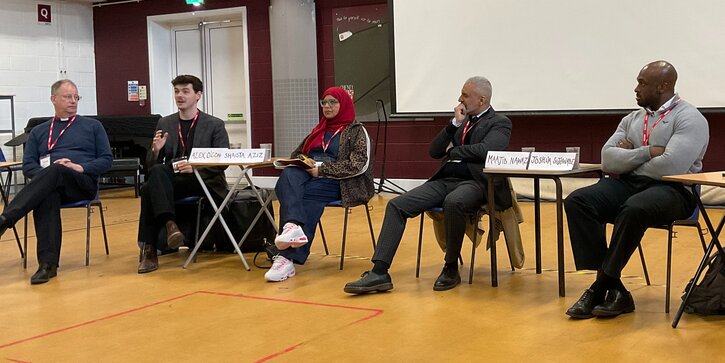
On Tuesday, the Rumble Museum at Cheney School organised a Tree Conference for 150 young people aged 16 to 17. Students started the day in woodland around the city, where they were encouraged to soak in the early morning atmosphere and sounds, and look around at the trees and the wildlife.
 

There was then an opening talk about Remarkable Trees by Professor Yadvinder Mahli CBE from the University of Oxford. Yadvinder spoke about how trees displayed intelligence in the sense of solving problems, though over a much longer timeframe than humans. He gave us a tour of some of his favourite trees, including a tree in the rainforests in Congo which produced a yellow fruit eaten by forest elephants. 


For the rest of the day, students were in groups of their choice, taking part in a range of workshops delivered by experts. These workshops included identifying tree DNA with Henry Hung and exploring Dendrochronology with Jennice Singh, both from the University of Oxford. Students also explored Tree Medicine through artefacts from the History of Science Museum and Multaka volunteers, and trees and well-being with Dr Jess Fisher and Dr Gail Austen from the University of Kent’s Ecology Department. 


From a creative angle, students wrote tree poems with local author Julia Golding, created wood and glass mosaics with Becky Paton, made tree prints on the Rumble Museum's Albion Press with Bodleian Library printmaker Richard Lawrence, and took part in rush weaving with Katrina Green. Students also created tree art with local artist Emma Coleman-Jones, and made a film about trees with Film Oxford. 


On our own site, students explored moths and trees with Dr Liam Crowley (including discovering four species of moths on site overnight), and took part in a tree planting workshop with George, Stuart and Tom from the Tree Planting and Aftercare Council Services, which culminated in planting three new trees on the school site (a maple, a copper beech and a Scots pine). Two of the trees were kindly donated by "Rosara" at Nicholson’s, and the Scots pine was grown from seed by Paul Spicer in 2021. 


It was a fascinating day exploring the science and beauty of trees, and we are very grateful indeed to our speaker, workshop runners, and everyone who took part in any way.


Warneford 200 Project

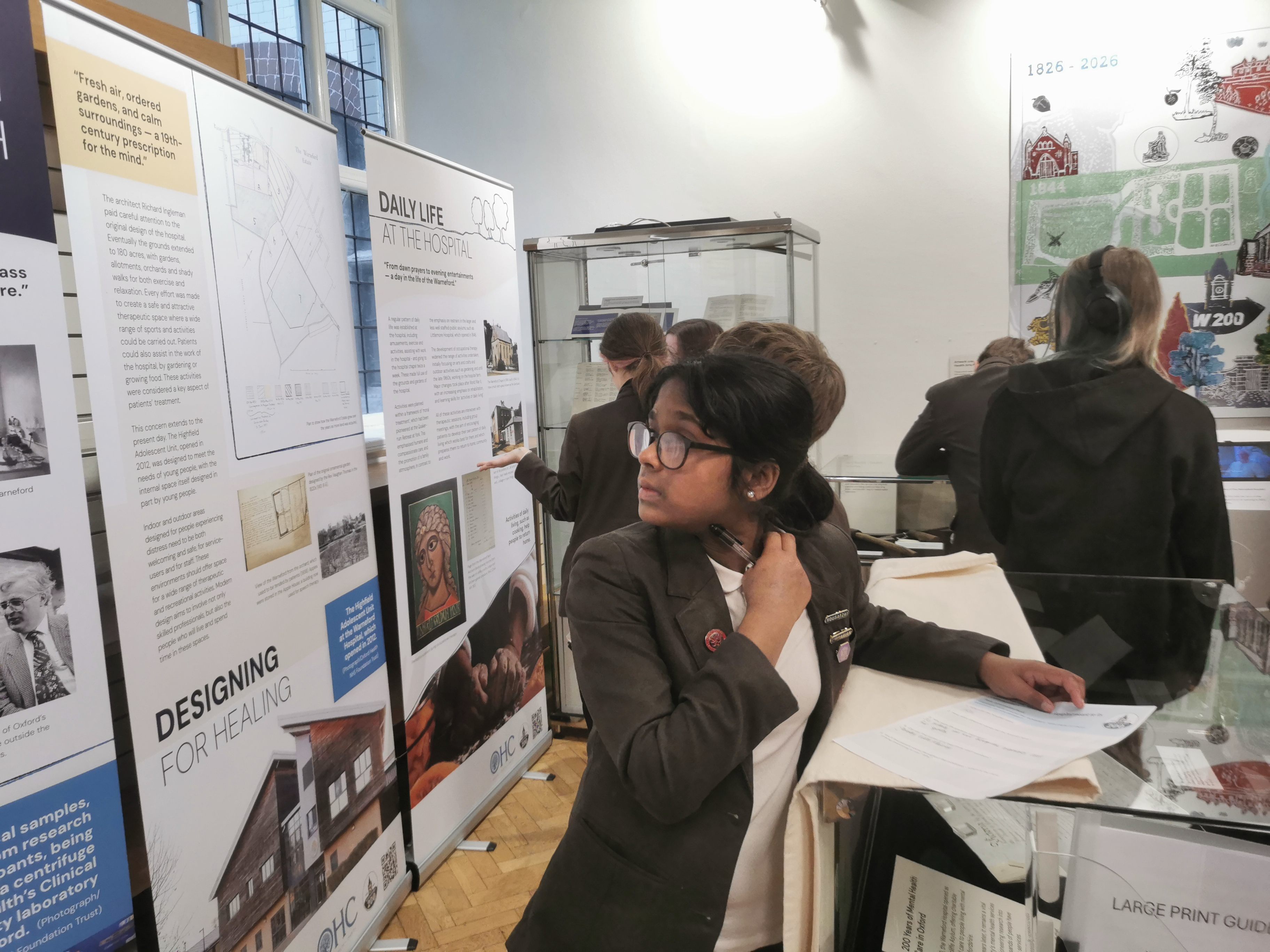
Year Eight Museum Council students had a fascinating visit to the Museum of Oxford on Tuesday afternoon to start a new project exploring the history of the Warneford Hospital. 
 
The Warneford Hospital is celebrating its 200th year this year, and as part of this, an exhibition has been created to display the long and interesting history of the hospital, which includes patient and staff stories, artefacts of medical treatments used, and panels detailing the story of its development. 
 
Year Eights were greeted by Zaiba Patel, Sally Frampton, both University of Oxford historians, and Molly, a researcher in psychiatry. They were asked about what they knew about the Warneford already, and explored some of the language used historically around mental illness. 
 
They then looked at four different sources: a poem, and two letters by patients, all expressing very different perspectives and experiences, and a document with instructions to the "keepers" dating to the 1800s. 
 
The students were also able to spend some time looking closely at the exhibition itself, and listening to the stories using headphones.
 
The group will be creating a new locker display with some of the sources they've encountered, which will also be used to create a new panel for the Warneford Exhibition, which will be touring the county later next month. 


Rumble Museum Takes Over City Centre Shop Windows!

 
The Rumble Museum at Cheney School has decorated an empty shop window at No 8 Broad Street in the Oxford City Centre with a range of its artefacts and exhibits. 
 
The display, designed by the museum's director Dr Lorna Robinson and created with the help of Year Twelve students from Cheney School, consists of two windows. The first window showcases some of the museum's replica artefacts from the Minoan Civilisation, people who thrived on the island of Crete and surrounding areas in the second millennium BC. There is a replica snake goddess, Phaistos Disk and sistron, and the centrepiece is a mosaic featuring a Minoan woman gathering saffron, made by visitors and students at a community festival, under the guidance of local mosaicist Clare Goodall.
 
The second window exhibits the many nature projects the Rumble Museum organises, and includes dragonflies designed by St Andrew's Primary School and Bayards Hill Primary School, mosaics of two moths found in a student survey of moths on site at Cheney, and tree trunks from an Indian Bean tree which had to be cut down. It also includes a model of a tree made by Year 12 art student Felix Spier. 
 
The displays provide an opportunity to show some of the exciting and wide-ranging projects the museum runs at Cheney and with the local community, and a chance to show some of the very large collection of original and replica items at the school. 
 
The exhibitions will be in the windows for the next two months and maybe longer, depending on when the shop unit is sold. 


Black Holes and Orreries at our Astrofest

We were very grateful to the many visitors who braved a rainy evening to attend our Astronomy Festival on Friday.
 
The event kicked off with Y12 songwriter Rachel Sophia performing some of her own songs inspired by the night skies, followed by a fascinating opening talk by Katie Savard from the University of Oxford which explored the science and wonder of black holes.
 
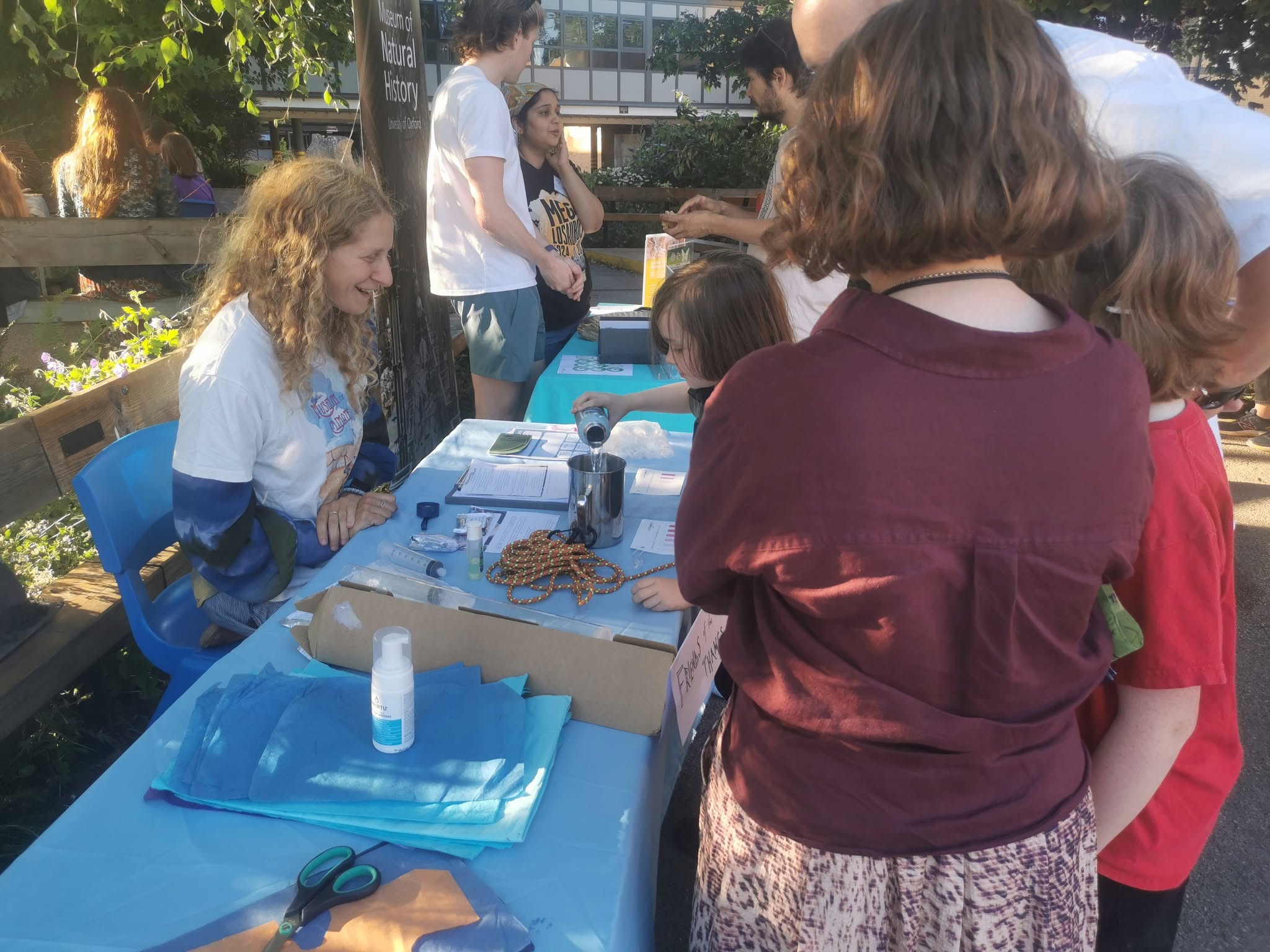
Between 6 and 8pm, visitors were able to explore a wide range of stalls, many of which were designed and run by our Museum Council students, ranging forms spectroscopy and moon cakes to constellations and designing planets! There was also Y12 facepainting and refreshments run by Cheney Friends.
 
We were very lucky to welcome external visitors too, including History of Science Museum who brought beautiful artefacts, Oxfordshire Polish Association, who informed visitors about Helvetius and the moon, Natty Mark Samuels who spoke of African folklore and the stars, and Oxford University Physics Department.
 
A range of visiting enthusiasts brought their telescopes for people to explore, and planetarium shows ran all evening. 
 
We are so grateful to all our visitors, our speaker, our student volunteers and stallrunners for a stellar evening!
 
Photograph by Y10 Friday Scott Buck.


Arboretum Project continues with "Trees through Time" lecture

On Thursday 20th November, the Year Nine Museum Studies group were invited to attend a lecture by palaeobotanist Jennifer McElwain on "Trees Through Time". The group are very privileged to be working with the Arboretum this year on a project developing new signage, and the talk formed part of a series of visits and workshops which are developing their thinking and understanding of trees, arboreta, and public engagement. 
 
The talk began with an exploration of what makes a tree - Jennifer explained the categories were not completely clear cut, but usually a tree would have a woody, self-supporting stem, be perennial, and have a crown. She also pointed out that a forest is not simply lots of trees together but a dynamic system, in which trees are the dominant part. 
 
She explained how trees have evolved significantly over time, and we looked at the earliest fossils of trees from the Devonian Period, and the earliest known specimen, from Devon in the UK. Trees at this time reproduced with spores, and did not have leaves. As time went by, leaves and seeds appeared. 
 
She looks in her research at "stomata" on leaves and how the numbers of these increases when carbon dioxide levels decrease, and vice versa, so it shows how trees are witnesses to climate change. She also spoke of the limitations of trees - how for example, in modern day Greenland, it is largely too cold for trees, just as in desert climates, it is too arid and hot. 
 
We looked at a recreation of what Greenland was like in terms of forestation in Jurassic times, and how fossils and an artist's work helped to create illustrations of the forests which abounded there at the time.
 
Finally, she looked at trees now and how well they respond to pollutants. She found that evergreen trees seemed to be more resistant to pollution in the environment than deciduous trees which she dubbed as having a "live fast die young" strategy!
 
It was a fascinating talk, and we will really look forward to seeing what ideas it has planted in the minds and imaginations of our Year Nine group as we continue work with the Arboretum and Dr Lauren Baker this year! 


"Making" Season and Conference

In March 2025, the Rumble Museum celebrated the history of Cheney School, and especially its legacy of making and crafting of all kinds. One of the schools which went on to form Cheney School was Cheney Technical School, founded by John Henry Brookes, a craftsmen and educator. You can find out more about the history of the school here.

This involved a project with sixth form museum council students digitising a vast array of school reports, photographs, magazines and other materials which have been donated to the Rumble Museum. One of many items donated to us has been this school report from 1960, which alumnus Bernard Stone has been kind enough to let us reproduce. As you can see, there is much that has changed about reports, as well as some things that remain the same! The report gives some idea of the technical, crafts-orientated education which took place at the Technical School.

As well as this project, the museum organised a sixth form conference on Tuesday 11th March which celebrated the technical school’s history and legacy, with a range of all day workshops, where students were able to make something - from mosaics, clay cities, jewellery and globes, to printing, songwriting, short storywriting, and more. We were very excited to see what our Year Twelves all produced!


"THIS IS WHAT YOU GET": Rumble Museum project with new Ashmolean Radiohead Exhibition (2)

Museum Students in Year Eleven and Twelve at Cheney School in east Oxford were very excited to be taking part in a collaborative project involving the forthcoming exhibition "This is what you get" at the Ashmolean.

It is the first exhibition in a public gallery to bring together the visual work of Stanley Donwood and Radiohead's Thom Yorke. The Ashmolean state: More than 120 works will be on display, with many of the paintings, drawings and digital art specifically created for Thom Yorke’s internationally acclaimed band Radiohead, formed in Oxford in 1985.

The young people were invited to attend a session where the director of the exhibition presented ideas for the exhibition, and students were able to offer feedback and suggestions to be incorporated into the exhibition. Students were asked, before the visit, to choose a Radiohead album cover or song and prepare a creative response: this could be a poem, piece of artwork, or song. The Ashmolean was particularly keen on these responses being collaborative projects, since the exhibition itself is focused on a collaboration.

Students produced new songs, artwork, poems, voiceovers, and videos - all inspired by the cover art and music of Radiohead. The Ashmolean have created a special exhibition page for the students' work here

We are very grateful to have been able to collaborate with the Ashmolean on this first of its kind exhibition. Rumble Museum students had chosen Radiohead's OK Computer to feature in a permanent new Music Technology Exhibition at the school. 


Vintage toys and games at Rumble Museum's Toys and Games Collection afternoon

A 1930s wooden train, an original set of scrabble, and a cash register with shillings and pence were some of the items which came through Cheney School's doors at the Rumble Museum's Collection afternoon yesterday.

The Museum of Oxford was there with a range of artefacts to display too, and Ms Gersh,  data manager, brought some of the toys she had designed in an earlier career as a toy designer! We were also delighted to welcome Bernard Stone, an alumnus from the Cheney Technical School in the 1950s who brought an impressive array of objects. Students, staff and parents were able to explore artefacts and share their stories of childhood. BBC Radio Oxford were also there to speak to people about their experiences of childhood.

A community vote on favourite toys was also held, and lego came out as the winner!

All these stories and objects will slowly begin to be turned into a brand new exhibition about the History of Childhood, which will be displayed in converted old lockers.

The exhibition will be curated by our Museum Council students, with support from the Museum of Oxford, and will be launched later in 2025.

We are still very much open for any donations of toys, games and books from childhood - please email This email address is being protected from spambots. You need JavaScript enabled to view it.

Rumble Museum students and staff present Holocaust Candles project to the King at Buckingham Palace

On Monday 13th January, Cheney School students Amy Bedding (Year Eleven) and Nadia Heer (Year Eight) were invited to present their Holocaust Memorial candle holders project to the King at Buckingham Palace.

In October, students from Rumble Museum Council groups in Years Eight, Nine, Ten and Eleven took part in a project designed by Beth Jones from the Museum of Oxford, and funded by the Holocaust Memorial Day Trust as part of their 80 Candles for 80 Years project.

The project involved Museum Council students from Cheney hearing the moving story of Holocaust survivor Anita Lasker-Wallfisch, a cellist who survived Auschwitz by joining the Women’s Orchestra. The students discussed how museums can engage with and exhibit difficult histories, and they each then worked on decorating an individual candle-holder, thinking carefully about how their design might reflect the story and themes we had been discussing. While decorating, a piece of music by Karl Jenkins was played.

Nadia and Amy were able to talk about their designs for several minutes to the King, who met them, accompanied by Holocaust survivor, Manfred Goldberg, and asked them questions about their designs and their thoughts.

Amy explained how her candleholder was decorated with musical notes, alluding to Anita’s musicianship, and also broken glass, which symbolised her experience in Auschwitz. There are also human figures that show Anita’s community and orchestra, through which Amy said “she and others were able to join together and share a common human experience and keep hope alive in order to survive”.

Rumble Museum Founder and Director Dr Lorna Robinson and Museum Lead and History Teacher David Gimson accompanied the students to Buckingham Palace.

Oxford linocut prints in The Birder

St Giles' Cafe, Gloucester Green, Martyrs' Memorial, Cheney School, Lady Margaret Hall, C.S. Lewis Nature Reserve, and St Mary and St John Church are some of the well-known locations around the city which features in a new novel illustrated by handmade linocut prints featuring birds. 

The new novel The Birder is set in a mysterious Oxford city where people transform instead of dying, and where an ancient poem by Ovid might hold the key to the mystery at the heart of this strange yet familiar universe. 


Since witnessing her brother change into a blackbird at an early age, Merel has never felt quite at home in the world.

She embarks on a journey through science, religion, art and philosophy in her effort to come to terms with her loss. When she discovers a copy of Ovid’s Metamorphoses in her local library, she soon becomes convinced that her world was not meant to be this way, and that this book holds the secret for putting things back on track.

Illustrated with linocut prints of birds around the city of Oxford, The Birder creates a mysterious world that is filled with familiar sorrows and joys.

Dr Lorna Robinson is the founding director of the Iris Project, a charity which runs a range of classical initiatives in state schools and communities. She is also the founding director of the Rumble Museum at Cheney School, the first fully accredited museum as part of a school.

She has previously published a series of storybook courses Telling Tales in Latin: Parts 1 and 2, and Telling Tales in Greek. She has also published Gabriel Garcia Marquez and Ovid: Magical and Monstrous Realities.

More recently, she embarked on a fiction project with illustrator Lydia Hall, which involved re-imagining Greek myths connected to plants. Together they published four small books in the series, Telling Tales in Nature: Underworld Tales, Forest Tales, Orchard Tales and Meadow Tales. These are now published as a compendium.

Lydia Hall is an illustrator and printmaker based in Glasgow. She has worked, both on personal projects and with schools and organisations, to create bold narrative based work. With an emphasis on collaboration, she seeks to use her practice to tell thoughtful and intriguing stories.
 

The book is available to purchase as hardback, paperback and ebook here.

Festival of Birds, Tuesday 4th February, 3 - 5pm

We were delighted to hold a Festival of Birds at Cheney School on Tuesday 4th February, 3 - 5pm.

The event was the first of a series of events celebrating the nature around us, as we began an extended series of miniature events.

There were a range of bird-themed information and activity stalls, including scientific, artistic, craft and storytelling explorations and celebrations of the birds around us. There were also refreshments available and a live bird display. 

Visitors were able to find out about the birds around us, and how they inspired ancient myths, stories, art and more through the ages. There were a number of local scientists and artists talking about how their work has been inspired by birds.

We also displayed prints of birds from magical realist, bird-themed novel The Birder, set in Oxford, and written by Rumble Museum director Lorna Robinson.


Stories from Childhood: Your Favourite Toy

The Rumble Museum is running a Toys and Games Stories & Collection Afternoon on Tuesday 3rd December, from 3.30 to 5pm at Cheney School.

We are inviting members of the public to visit with any stories about their childhood toys and games, as well as items they would be happy to donate to our forthcoming exhibition on A History of Childhood. There will also be artefact-handling, refreshments and activities for all ages.

The exhibition will be curated by our Museum Council students, with support from the Museum of Oxford, and will be launched later in 2025. We are looking for toys and games of any kind and from any era, up to the present day. The exhibition will see lockers converted into bespoke display cases for this collection.

Visitors will also have the option of donating their toys and games to the Christmas charities if items are not used in the exhibition.

As part of this event, we are keen to discover what Oxford's favourite toys and games are! If you would like to help us find this out, you can fill in this form to let us know what toys and games were a key part of your childhood. We will use these to help shape our exhibition.

We look forward to hearing your stories!